Transboundary river basin water balance with integrated methodologies and adaptation to climate change

About the project

WABIN is a cross-border cooperation project co-funded by the Interreg VI-A Italy–Slovenia Programme. It promotes the sustainable management of water resources and the protection of aquifers by integrating hydrogeological, geophysical, geochemical, isotopic and climate data at river-basin level. Focusing on the Isonzo/Soča basin, the project combines an integrated methodological framework, a three-dimensional hydrogeological model and water-balance forecasting to improve knowledge of water availability, use and future climate-related pressures. WABIN also brings together public authorities, researchers, businesses, territorial stakeholders and citizens to strengthen shared, participatory governance of cross-border water resources.
Results

WABIN is developing practical knowledge, tools and cooperation mechanisms for more resilient cross-border water management. Key achieved and expected results include:

  • An integrated cross-border GIS database that organises and visualises geophysical surveys, hydrogeological measurements, lithostratigraphic, geochemical, isotopic, atmospheric and monitoring data for the Isonzo/Soča basin.
  • A calibrated and validated three-dimensional hydrogeological model of the Isonzo/Soča alluvial aquifer, supported by long-term datasets and field investigations, to analyse groundwater dynamics and the water balance.
  • Climate-change scenarios and forecasting tools to assess future water availability, demand, recharge and the vulnerability of sensitive areas, supporting more informed and resilient planning.
  • A transferable integrated methodological package for characterising hydrogeological basins and estimating the productive potential of natural water resources.
  • A public–private cross-border network and a Memorandum of Understanding setting out shared priorities and an action strategy for the protection, monitoring and management of water resources.
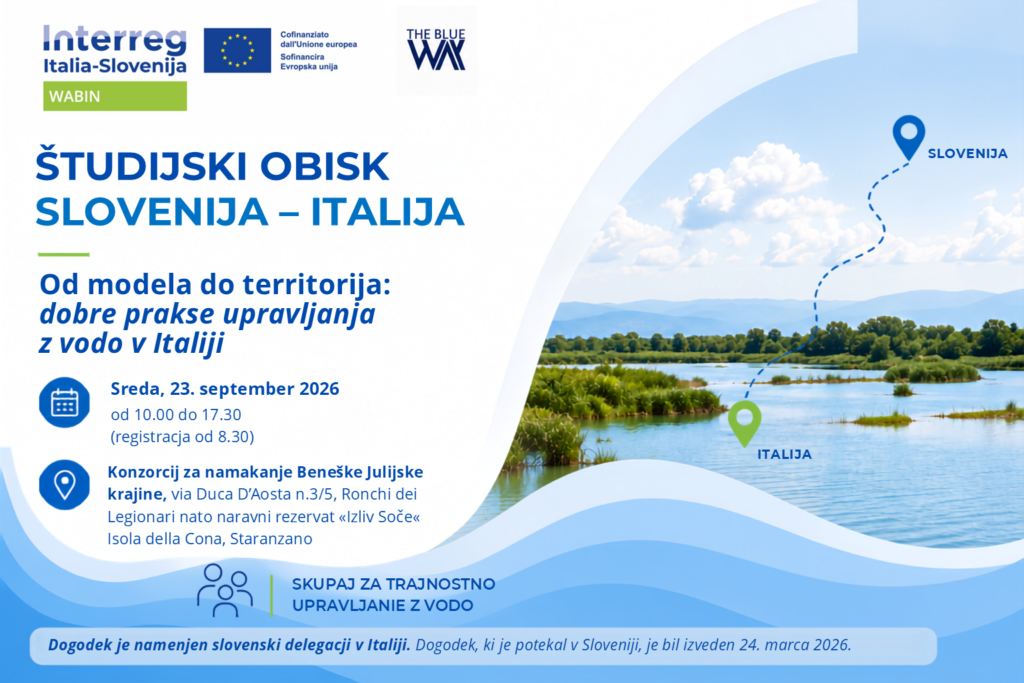
  • Territorial focus groups, study visits, technical workshops, citizen-science and awareness-raising activities that engage institutions, experts, businesses, local communities and young people in sustainable water governance.